Saturday, January 3, 2015

Aluminum Christmas Trees

I can still talk about Christmas in January because technically Christmas, as a season, lasts until Epiphany (that's where the "Twelve Days of Christmas" come from).

If you grew up with A Charlie Brown Christmas, you can probably guess from the title of this post where I'm going with this. If you didn't, I suggest you watch it at least once; you've still got a day or so before you have to wait until next year to do so.

http://www.acartoonchristmas.com/wp-content/uploads/2010/12/tree-farm-LARGE.jpg
Not pictured: explanation for selling fake trees outdoors. (Source: http://www.acartoonchristmas.com)
As a kid I was confused by the total absence of a normal green tree in that tree lot Charlie Brown and Linus visited, the closest thing being some kind of clipped branch. Growing up in my house, we had a fake (non-aluminum) tree, but it was green like a real tree, so that was ok. And while I can sympathize with the special's commentary on the rampant commercialization of a religious holiday, I remember our tree saved us money and maintenance; my folks are still using it after decades.

You may be surprised to learn that these aluminum non-green trees really existed even before this aired in 1965.
Source: Wikipedia
I look at that tree of a different color, and I begin to wonder whether such a thing could exist on another planet.
Imagine a planet though, with a cold climate (though not quite as bad as Coldstone), with forests of these things, with their colors (read, photosynthetic pigments) varying by climate zone, altitude, etc. They would really have aluminum integrated into their structure to make them more durable too. Of course, they might have some other metal that's less reflective; reflective plants probably wouldn't take in as much light or heat from the sun.

Tree colors are randomized here. As I've said before, what one would expect doesn't always correspond to what one finds in reality. Also, I think I've actually gotten worse at rendering planets.
For bonus points, maybe these evergreens bear bioluminescent fruit, so at night they really do look like Christmas trees strung up with lights!

I'm going to call this planet "Linus", as a tribute to the Peanuts gang for giving me this idea.

Merry Christmas, and have a good 2015.

Monday, November 24, 2014

Naming Exoplanets

With the USA midterm elections safely behind us, let's turn our attention to an election of an entirely different nature, probably less important but still worth getting informed about.

A few months ago, the International Astronomical Union announced its intention to begin a campaign to involve the public in naming extrasolar planets. And I'm not talking about the existing names like HD 40307 d.

My first reaction is, "About time." The IAU probably is best known to the general public for demoting Pluto to the status of "dwarf planet", so one could interpret this as an attempt to win back the crowd.

Now, of the hundreds of planets discovered so far, only 305 are being named by this campaign. (They are listed at http://nameexoworlds.org/). What's going to happen is, ideas will be submitted to registered astronomy clubs and non-profits worldwide, and in January these organizations will each select the top 20-30 planets they want to name, followed by the proposed names. We, the general public, will get to vote on the final ballot in April, and the results will be announced in mid-August 2015.

Now, I like that planets are getting human-readable names, even if they're only a fraction of all the planets we've found so far (makes sense; they probably don't want to waste names on unconfirmed planets that later turn out to be false positives). However, one of the conditions of the proposed names bothers me. Most of the conditions are what you would expect: maximum length of 16 characters, preferably one word, no intellectual property names, etc. I wonder, however, if a severe mistake is not being made by requiring names be "not too similar to an existing name of an astronomical object".

That's a problem.

It's common in fiction to name extrasolar planets after figures from classical mythology. I'm sure a lot of people hope to make that concept reality with the discovery of new worlds. Unfortunately, take a brief wiki walk here. Look at the names of the minor planets in our solar system; notice that a lot of the mythological names are taken. By glorified rocks. I know I've said before that the distinction between "planet" and "asteroid" is largely a matter of semantics, but only "largely". You can't deny that a world like Mars or Earth and an asteroid like Vesta or Juno are not the same thing. So we have a wide array of evocative names that we may not be able to use like RomulusRemus, Hestia, Pandora, Janus, the list goes on and on and on and on!

We shouldn't be afraid to have more than one astronomical object with the same name. We aren't afraid to have countless Washingtons, Franklins, Springfields, or Greenvilles. Look at Georgia: is it a state, or a country? If we're going to force ourselves to be bound by decisions made by astronomers decades or centuries ago, then science is broken somehow. The organization that said Pluto is no longer a planet shouldn't be getting cold feet about reusing the name of a flying rock. If 51 Pegasi b can't have its unofficial name "Bellerophon" made official because it's already taken by an asteroid so obscure its size isn't listed on Wikipedia, something. is. wrong.

Maybe I'm overreacting. Look at that list of minor planets and you will see some duplicate names, like Dione, which is also the name of a moon of Saturn. So there is a chance the IAU will be happy to reuse these names. I sincerely hope so. This campaign has the potential to bring extrasolar planets into the public eye, and isn't that in the IAU's job description somewhere? It should be.

Sunday, November 16, 2014

Interstellar and the Worlds Therein (Spoiler-Saturated)

So guess what movie I saw last weekend. Go on, guess.

Christopher Nolan's Interstellar is our generation's 2001: A Space Odyssey, for better *and* worse. A science-fiction film with highly realistic depictions of astronauts and space travel, with entertaining robots and a confusing and highly implausible ending. Only this film is much less "arty" than Kubrick's 1968 work, and in my mind, that makes it better.

For starters, though, it's misnamed. They should have called it Intergalactic, because the (absolutely gorgeous) wormhole leads to...somewhere in another galaxy. But the title they went with sounds more cerebral, and I'm ok with that, because it's that kind of movie. I also can't remember the last time a movie soundtrack relied heavily on a church organ, and that's a shame, because it is truly something to behold, making the exploration of space into something like a religious experience, beholding creation untouched by man.

The trailers were all tantalizing, promising memorable alien worlds. In the end, we get to see three, plus a black hole for good measure.

That's right, this movie tours a solar system where the primary is a black hole. The matter spinning around and falling into it seems to be what generates light and heat for the orbiting planets, but...that's either really creative or really stupid; I still can't figure out if it's done with enough class and the appearance of realism to pull off creative. From what I remember, black holes are small. As small as the Earth if not more so.

In the plot exposition we find out that astronauts have been dispatched through a new wormhole near Saturn to a dozen potentially habitable worlds in a quest to find a new home for the human race. It's not clear whether these are all in a single star system; a neutron star is also mentioned briefly. The wormhole is humanity's only means of traveling faster than light, from which you can infer that there is only one star system to explore. However, the mission of the Endurance only seems to be interested in three. Maybe I need to rewatch this movie; it'd certainly be good on Blu-ray.

So in order of appearance:


Miller's Planet

Mainly this will be remembered as the planet with ludicrous time dilation (1 hour Miller's Planet time = 7 years Earth time), serving to set up character drama when the protagonist leaves the planet after a few hours to find his kids are now adults and he has a grandson. I can empathize; I've occasionally sat down to play FTL: Faster Than Light for "just one game", and emerged to find the global political landscape completely unrecognizable.
Now I think these time-stretching shenanigans should be accompanied by lethal gravitational forces, although I've heard conflicting interpretations. Due to poor life choices, I am not a theoretical physicist, so I will not enter that debate. I guess what matters is, it makes a good story.

What confuses me more, however, is the terrain. All we get to see is an ocean that's about two feet deep, which is in and of itself bizarre (I'm going to assume the whole ocean isn't like that). More confusingly, somehow waves are generated about two orders of magnitude higher than that. We see two 200-foot mega-tsunamis within about 5 minutes local time. Are these waves triggered by the massive tidal forces from Gargantua, which has already been established as too close for comfort? Or do the waves start in deeper water and then gain height as the depth decreases? (If you've ever been in a wave pool, you may have noticed that the waves seem more intense in the shallows.)


Mann's Planet

Um...

Frozen clouds.

This planet is definitely the most creative of the three we see, and also the most insane. Most of the action seems to take place on glaciers that look like clouds, resulting in some bizarre topography. As I said before, I don't know if this could ever happen in reality. Most would call it "absurd" unless you're from Minnesota, like me, in which case you'd be more likely to call it "January." If it could happen, Christopher Nolan is the greatest. If not, well, he wouldn't be the first to pull a stunt like that. But even James Cameron's Avatar had superconducting unobtanium to justify Pandora's floating mountains.
We're also told there's a surface below, but given that the guy describing the surface clearly couldn't be trusted, there's no hard evidence.


Edmunds's Planet

Only glimpsed at the very end, this looks like a desert planet (or, a planet with at least one desert). It's implied that this planet could indeed sustain a human colony.

I was hoping for more screentime spent exploring alien worlds, but I'm not exactly surprised; not many sci-fi movies give front-and-center focus to their settings. This movie's just crying out for a companion book that describes the setting in more detail though; maybe it could tell us about the other planets that astronauts were sent to before the mission depicted in the movie.

But nitpicking aside, Interstellar is a good movie. Flawed both technically and philosophically, but worth seeing.

Monday, October 27, 2014

Interstellar's Surprisingly Good Tie-In App


So Christopher Nolan's Interstellar is coming out in less than two weeks and I'm super-excited. Makes it easier to deal with the fact that No Man's Sky hasn't been released yet. For a little while.

In the meantime, Paramount has released the contractual tie-in game on the Google Play Store and the iTunes store. So what kind of free-to-play iOS/Android schlock game did they release solely to promote a movie?
Surprisingly enjoyable free-to-play iOS/Android schlock, that's what.
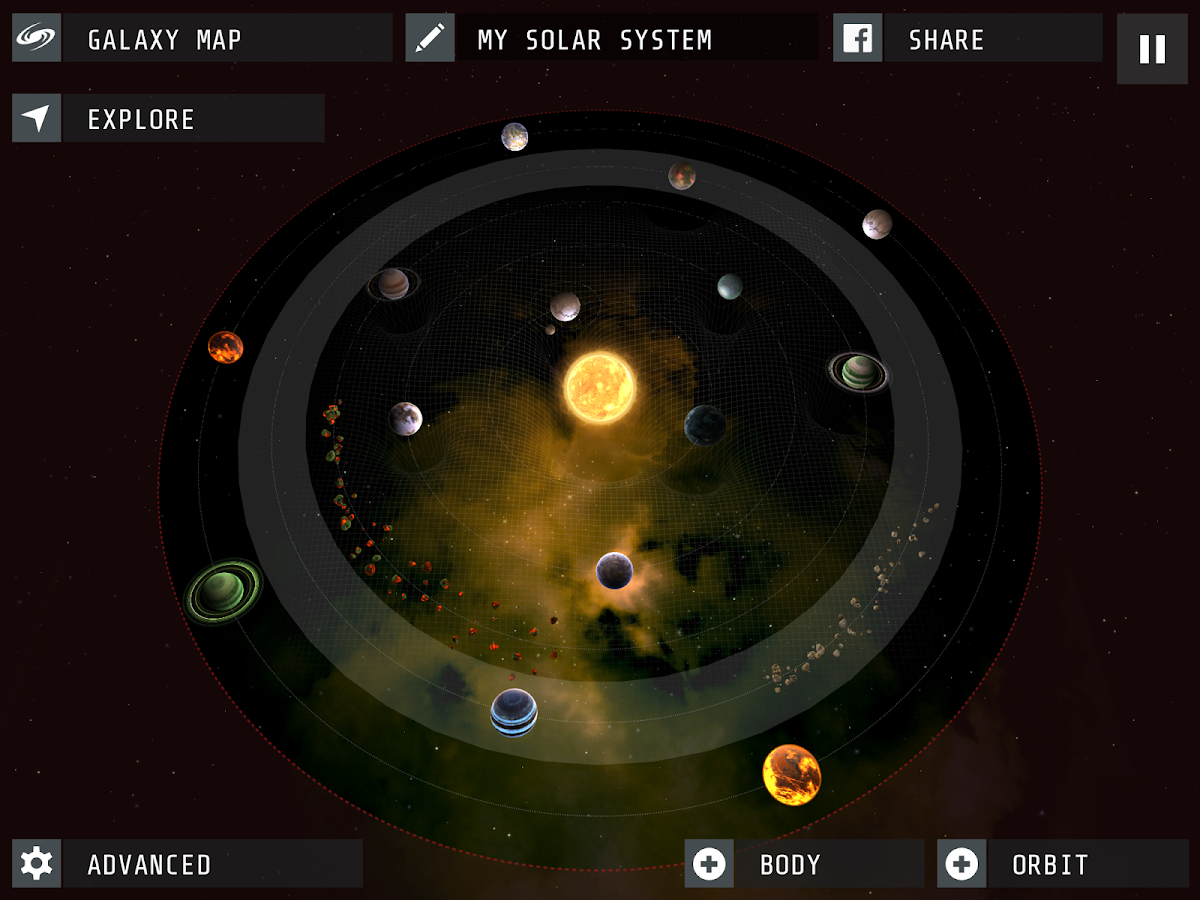
Interstellar - screenshot
More planets than an entire season of Star Trek. Right here. (Image source: Google Play)
It's a tie-in game, but a good tie-in game. Build your own solar system, then explore other people's. Manage fuel levels and plot out a course, making and breaking orbit as you explore the universe for the good of mankind. Not too hard to learn, and the touch controls work pretty well. There aren't enough games out there that try to capture that "astronaut" feel.

Go try it out. Hey, it's free.

Saturday, October 25, 2014

Classifying Planets


When I was a kid, I learned that there were two kinds of planets: rocky planets and gas giants. Rocky planets were small, and had solid surfaces and molten cores. Gas giants were big, had no solid surface, but a solid core. I learned that there were nine planets, that Earth had a moon, and that some of the other planets had moons and oh look it's time for math.

I never had much confidence in the school system's ability to get students excited about space travel. By the time I was twelve, I felt I knew more about space than any class would teach me. (In middle school, you just start to get a taste of the enlightenment every high schooler is convinced they possess. None of them actually have it.)

I think the moons of Jupiter and Saturn deserved at least a day of attention sometime in those twelve years. A volcano moon, an ice moon that may have an ocean underneath, a moon covered in yellow fog with oceans of methane! It would blow a kid's mind.

We're discovering a lot of new things, and discoveries tend to force revisions of existing classification schemes. This happened to Pluto, but that's not what I'm talking about.

Planets like Kepler-22b break the old idea of terrestrial and gas planets. Here's a planet that may have an ocean hundreds of miles deep. Do we still call it a terrestrial planet?

Closer to Finding an Earth
"Great, now we have to revise all the textbooks, and all the students will just assume we're trying to milk them for more money. Again." (Image source: NASA)
When I was in high school, I played a demo for one of those ridiculously complex "4X" space strategy games. I remember the game had not two but three categories of planet: rock, gas, and ice. With that, and water planets like Kepler-22b, and some time wasted browsing Wikipedia again, I got an idea for a new scheme:

Type I: Gas

The large planets with which most are already familiar. I'd like to see more creativity with gas planets in sci-fi, as the idea of airborne life forms in a gas planet isn't completely impossible...

Type II: Ice

Different from rocky planets, in that they are solid, but composed primarily of volatiles, like water ice, or solid methane or ammonia. They might have thin atmospheres, allowing seas of liquid nitrogen or something.
Since Pluto's not a planet, there aren't any "ice planets" in our solar system, though there are lots of minor planets that fit that description. Notably the Centaurs, which come in a surprisingly wide color palette.
File:TheKuiperBelt Albedo and Color.svg
"TheKuiperBelt Albedo and Color.svg" by Chesnok. Licensed under Creative Commons Attribution-Share Alike 3.0 via Wikimedia Commons - http://commons.wikimedia.org/wiki/File:TheKuiperBelt_Albedo_and_Color.svg

Type III: Pelagic

Planets like Kepler-22b, covered entirely, completely, in oceans many miles deep (I won't attempt to set a specific threshold). These planets could look very much like Earth's oceans, or they could be supercritical, lacking a defined surface between sea and sky. The high pressures on the ocean floor could also result in exotic forms of "hot ice".
These oceans don't have to be water. They could be another volatile substance, like ammonia, for example.

Type IV: Terrestrial

The vast majority of fictional planets would be this type, as would any real planets capable of supporting life as we know it, Jim. If an ocean planet has any landmass above the surface, any at all, it is probably terrestrial rather than pelagic.

Type V: Vulcanian

This is a planet where the surface is entirely lava, not just a planet with volcanic activity. Mustafar in Star Wars would not fall under this classification, due to having a lot of solid ground. In fact, I can't think of any planets in sci-fi that fall under this classification. We don't yet know for sure if there are any real planets of this type exist, although candidates exist, such as Kepler-10b.

Artist Concept of Kepler 10b
Good luck having a climactic lightsaber duel here. (Source: NASA)
Of course this classification scheme already breaks down with the idea of ice giants, which are considered by some to be distinct from gas giants. Maybe we can call these Type Ib.

And a final word on the concept of a "planet". The word is derived from the Ancient Greek word for "wanderer", so in a sense you could apply the word to any object orbiting a star, be it an asteroid, Earthlike planet, gas planet, or protostar. When Pluto was demoted to "dwarf planet", I was told it was not a "planet". How is a "dwarf planet" not a planet?
We've long had the term "minor planet" to denote asteroids. I suggest we refer to the major 8 planets of our solar system as "major planets", and put major, dwarf, and minor planets all under the super-category of "planet".

Of course, the more we discover, the more we'll have to revise our scientific categories. So if my systems described here turn out to be completely wrong, I'm ok with that.

Sunday, October 19, 2014

Scenario: Coldstone

It's about time I put my money where my mouth is and did some worldbuilding of my own.

Despite being one of the few single-biome planet types that actually seems plausible, the desert planet concept is a bit overused. (And...a...bit...dry. ThereIsaidit.) So no desert planets right now. We'll go with the polar opposite: ice planet (I did it again.)

I tend to think that outer space, as a general rule, is cold. Punctuated by the points of light we call stars, the lone campfires in the interstellar wasteland. So a cold planet is more indicative of space than a hot one.

Probably the most prominent ice world in sci-fi is Hoth from The Empire Strikes Back. Of all the planets in the original Star Wars trilogy, it's my favorite; it's really the only one that gives the feel of a hostile environment: Luke nearly died of exposure, and the Rebels had to work to adapt their snowspeeders to function in the cold, necessitating beasts of burden (which still froze to death at night). It's clear that Hoth is someplace you don't try to live on unless you're an enemy of the state. We'd only colonize such a world in real life if we didn't have anywhere better to go (which isn't impossible, or even improbable; we'd be ecstatic to find a planet like Hoth in this day and age).
Source: "Hothplanetsurface" by Screenshot from movie The Empire Strikes Back. Licensed under Fair use of copyrighted material in the context of Hoth via Wikipedia - http://en.wikipedia.org/wiki/File:Hothplanetsurface.jpg#mediaviewer/File:Hothplanetsurface.jpg

But I think we can do better. Let's try to do better.

In eighth grade I read Ender's Game, then I picked up its sequel, Speaker for the Dead, which is not a horror novel, title notwithstanding. (Protip: I definitely do not recommend Speaker for eighth graders; it's too heavy.) Early in the story, the protagonist is on a planet called Trondheim, which is mostly frozen except at the equator. The fleeting description of this planet intrigued me at age 13, as it was the first planet I had seen in fiction that couldn't be summed up in one word. It's mostly icy, but the equator is temperate. From what I hear, Star Trek's Andorian homeworld is similar.

So a planet like that, even with more extensive icecaps than Andoria,, would be appealing for colonization. But need habitation be restricted to the tropics, with endless frozen wastes covering 90% of the planet's surface?

Let's try to do even better.

The now-invalidated Star Wars Expanded Universe has a world called Belsavis. It's like Hoth, but with warts.
Contagious? We'll see. (Image source: http://www.swtor.com/holonet/planets/belsavis)

I haven't played The Old Republic so I don't know how much explanation is given for these temperate rifts. It's just as well. More fun that way. I think they're analogous to "hotspots", localized areas of activity over which the Earth's tectonic plates drift, resulting in the formation of island chains like Hawaii (at least I think that 's how they work). These rifts in the global glaciers could be the result of geothermal heating, though not so intense that these rifts are dangerously volcanic. If the plates drift on this planet, maybe the rifts are transient, moving over time as land is ceded and reclaimed by the glaciers.

I think we now have enough ideas to build a complex ice world, which I am calling Coldstone. Below is my novice attempt to provide a visual.
Please don't laugh.

To ensure that the planet stays tectonically active, let's give it 7 or 8 small moons, gravitationally pulling on the planet in complex ways.

A significant portion of the planet is subsurface ocean, home to aquatic creatures living without sunlight. These include gigantic eel-like monsters that occasionally punch through thin regions of ice to prey upon the few creatures that live on the ice above, in a variation on the much-overused "sandworm" trope.

I'm going to make the plants blue. This discussion suggests that it could happen if plants photosynthesized with phycocyanin instead of chlorophyll. I don't know if there's a good reason for plants to be blue, but life doesn't always have to take the most efficient route, and I like the idea of blue plants on my ice planet. I think they also incorporate metals into their interior structure - maybe copper or aluminum - to conduct heat out of the ground and warm themselves. They store water in large spherical fruits...that have thick fur to warm themselves. Furry fruits! Colonists are divided on whether they're tasty or gross.

Most human habitation is in the tropics, but there are settlements in some of the rifts, connected by trains that travel on railroads in tunnels through the ice. Each rift has a unique ecosystem, existing in near-total isolation from the others. Some of the rifts are just lakes though. And on the ice itself, there are isolated encampments of survivalists, hermits, criminals, or hunters.

I did mention some creatures do try to live on the ice itself. I recently played through Capcom's Lost Planet: Extreme Condition, a game whose central premise is survival on an ice planet. Gameplay is rotated between fighting human enemies on foot, fighting human enemies in small mecha, and fighting alien creatures collectively referred to as Akrid. These creatures contain in their bodies a liquid referred to in-game as "thermal energy" or "T-ENG". It glows orange and serves as a universal energy source for colonists; your supply is continuously counting down and you'll probably freeze to death if you run out (evidenced by Akrid that freeze solid when killed and can be shattered).

I can only begin to guess how T-ENG works. If I had to hazard a guess, I'd say the Akrid synthesize something like liquid charcoal in their bodies, which burns very, very slowly, keeping their internal body temperatures normal. The appeal of a fossil fuel synthesized by living organisms is obvious. A valuable resource is a good way to motivate stories set on an alien planet.

So: good idea, or just cliche and/or hopelessly derivative? Should I do more of this kind of post? Leave a comment if you have any ideas of starting points for new planets.

Saturday, October 11, 2014

Star Wars Rebels first impressions, and forecasts for Episode VII

So the pilot episode of Star Wars Rebels broke last week, and the follow-up episode is available for free on iTunes (for how long though, I cannot say).

File:Star Wars Rebels logo.png
Image source: Wikipedia (http://en.wikipedia.org/wiki/File:Star_Wars_Rebels_logo.png)

First impressions:

TIE FIGHTERS WITH THEIR SCREAMING ION ENGINES! STAR DESTROYERS THAT TRACTOR YOUR WHOLE SHIP INTO THEIR DOCKING BAY!

THIS is Star Wars: ragtag heroes up against an evil empire. TIE Fighters have not been seen in non-Expanded-Universe material since 1983 and they. have. been. missed. It's a little early to provide much commentary, but suffice to say I'm optimistic that this will be even better than The Clone Wars.

Now for the new worlds we're seeing.

Lothal

Image source: Star Wars Database (http://www.starwars.com/databank/lothal)


Not much to write home about. All we see is grass occasionally interrupted by boulders. I'm actually ok with that concept; it's entirely possible that habitable worlds may only have very simple ecologies, especially if they are relatively young.

Kessel

Image source: Star Wars Database (http://www.starwars.com/databank/kessel)

First mentioned in passing by both C-3PO and Han Solo in the original 1977 movie, the spice mines of Kessel are a combination Imperial penal colony and mining operation / death sentence. It bears mentioning, though, that the writers seem to be intentionally working to get under the skin of diehard Expanded Universe fans.
The original Kessel, as detailed in Kevin J. Anderson's Jedi Academy trilogy and the formative-in-my-childhood-video-game Star Wars: Rogue Squadron, among others, was a non-spherical asteroid, with only a thin artificial atmosphere maintained by atmospheric generators, necessitating oxygen masks for anyone on the surface.

In the pilot episode, we get a split-second establishing shot of Kessel, but that's all it took for the writers to say, "It's spherical. We're in charge now." I don't exactly disagree with this decision, as the old Kessel was pretty ridiculous in hindsight, but it would've been nice to keep the oxygen masks, as it would reinforce the hostility of the planet's environment and the fact that any prisoners condemned there are essentially on their way to a death sentence. Star Wars could really use some more "hostile" planets. Even Mustafar can't be that hostile if you can walk around and breathe the air.

Now, looking a little bit forward. Fourteen months to be more precise:

Episode VII.

I've noticed that Star Wars is exhibiting a marked trend away from the generic single-environment planets I've complained about before. Recall that most of the standard environments are covered in the original trilogy: desert, jungle, ice, swamp, forest. The prequels begin to get more creative, with a termite-mound planet in Episode II, a sinkhole planet in Episode III (plus all the weird worlds in the Order 66 montage), and all the wacky worlds of The Clone Wars that I discussed at length in my earlier post.

The planets in Star Wars are getting more creative over time. Rebels may be a bit slack so far, but it still shows promise. Thus, I'm interested in what J.J. Abrams has in mind for the upcoming sequel. Recall that Abrams's previous "Star" film, Star Trek Into Darkness, opened on a planet with red trees, an ocean, and a supervolcano, all in about 5 minutes.
Image source: TrekMovie.com
I'd bet Mr. Abrams will bring similar creativity to Star Wars. And that's pretty exciting.